Impressions Up, Clicks Down in Search Console: 6 Causes
Short answer
Impressions rising while clicks fall means a site is seen more often but chosen less often. The 6 causes: AI Overviews, new low-position queries, query mix, device or country mix, search appearance, and bots.
In this article
- What does impressions up, clicks down mean?
- What are the 6 causes of impressions up, clicks down?
- 1. AI Overviews reduce clicks on regular results
- 2. The site starts appearing for queries at low positions
- 3. The query mix shifts
- 4. Devices or countries shift
- 5. Search appearance changes
- 6. Bots and rank trackers
- What is the fastest order of diagnosis?
- How do you explain impressions up, clicks down to a client?
- Frequently asked questions
Impressions up and clicks down means links to the site appear in Google more often, but users click them less often, so CTR falls. The pattern does not always mean rankings got worse. This guide maps 6 causes, how to check each cause in Search Console, and how to explain the pattern to a client.
What does impressions up, clicks down mean?
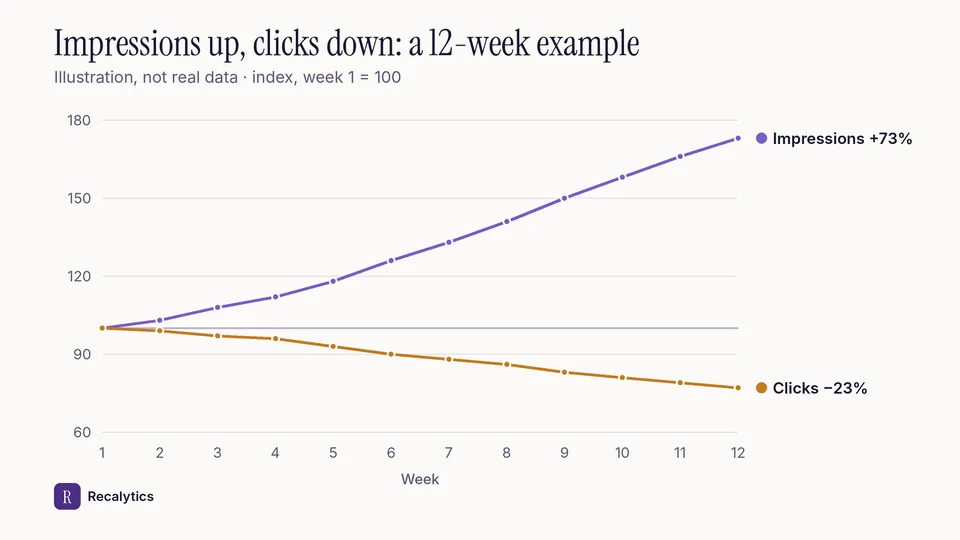
Impressions up but clicks down means the site's CTR fell, because CTR is clicks divided by impressions. Example: 1,000 clicks from 40,000 impressions give a CTR of 2.5%. The next month, 900 clicks from 60,000 impressions give a CTR of 1.5%. CTR fell by 1 percentage point even though the site was seen 20,000 more times.
The chart below shows the same pattern as an index, with impressions and clicks both set to 100 in week 1.
The definitions of impressions, clicks, CTR and position are covered in full in the guide to the Search Console Performance report.
What are the 6 causes of impressions up, clicks down?
The 6 causes of impressions up and clicks down are AI Overviews, new queries at low positions, a shift in query mix, a shift in devices or countries, a change in search appearance, and impressions from bots. Each cause has its own check in Search Console.
1. AI Overviews reduce clicks on regular results
AI Overviews lower the chance of a click on regular search results. Pew Research Center found users clicked a regular result in 8% of visits to results pages with an AI summary, compared with 15% of visits to pages without an AI summary. The Pew study used the browsing data of 900 US adults during March 2025.
Pew Research Center, July 2025: pewresearch.org
How to check: open the generative AI performance report and compare its impression trend with the total impression trend. Generative AI impressions growing faster than total impressions show that part of the rise comes from AI Overviews or AI Mode.
2. The site starts appearing for queries at low positions
New queries at low positions add impressions without adding many clicks. A page that starts appearing at positions 20 to 50 for hundreds of new queries raises total impressions, but links at low positions are rarely clicked. The site's average position usually gets worse at the same time.
How to check: in the Queries tab, filter Position greater than 10, then compare the number of queries and impressions with the previous period.
3. The query mix shifts
A shift in query mix lowers CTR when the share of non-brand queries grows. Brand queries, such as a company name, usually have a much higher CTR than general information queries. Seasonal queries also shift the mix: year-end sale queries raise impressions in December and fall in January.
How to check: create a Query filter with a regular expression that contains the brand name, then compare the CTR of brand and non-brand queries separately.
4. Devices or countries shift
A shift in devices or countries changes CTR because each device and country has a different results layout. A rise in impressions from a country whose language does not match the page language rarely produces clicks.
How to check: open the Devices tab and the Countries tab, then sort by the difference in impressions against the previous period.
5. Search appearance changes
A change in search appearance lowers clicks when the site's title, snippet or rich result is less attractive than other results. Google can rewrite titles and meta descriptions. Competitors can also earn rich results such as images or review stars.
How to check: open the Search appearance tab, then look at the live results page for the 5 queries with the biggest drop in clicks.
6. Bots and rank trackers
Impressions from bots and rank trackers can inflate desktop impressions. After Google stopped supporting the num=100 parameter in September 2025, Tyler Gargula's analysis of 319 properties found that 87.7% of sites saw impressions decline in Search Console. The biggest drop was in desktop impressions, and the average position of many sites improved sharply at the same time.
How to check: compare the desktop impression trend with the mobile impression trend. A spike in impressions on desktop only, with no rise in clicks, is worth suspecting as bot traffic.
What is the fastest order of diagnosis?
The fastest diagnosis starts with the date range, then moves to devices, queries, positions, generative AI and search appearance. The order rules out technical causes first, because technical causes are the cheapest to prove.
Match periods · 28 vs 28 days
Compare periods with the same number of days and the same weekdays. Search Console daily data uses Pacific Time.
Split by device · Desktop vs mobile
A desktop-only impression spike with no rise in clicks points to bots or rank trackers.
Separate brand · Brand regex
Compare the CTR of brand and non-brand queries. A growing non-brand share lowers total CTR.
Filter position · Position > 10
Count new queries at low positions. New queries at low positions add impressions with few clicks.
Check generative AI · AI Overviews
Compare the impression trend in the generative AI performance report with the total impression trend.
Inspect appearance · 5 queries
Open the results for the 5 queries with the biggest drop in clicks, then compare titles, snippets and competitors' rich results.
Ordered from the cheapest cause to prove to the most expensive.
How do you explain impressions up, clicks down to a client?
Impressions up and clicks down is explained to a client in 4 parts: the figures, the proven cause, the impact and the next action. Clients accept an explanation more easily when facts are kept apart from guesses.
The explanation becomes a fixed part of the monthly SEO report, in the top pages and queries section.
Frequently asked questions
Is impressions up, clicks down always bad?
No. The pattern also appears when a site starts being seen for new queries, which is often the first stage before those queries move up.
How much data is needed before naming a cause?
At least 28 days of data, plus the 2–3 day Search Console delay, before a cause is named.
Are AI Overviews recorded in the Performance report?
Yes. Impressions and clicks from AI Overviews are included in the Web search type of the Performance report, and one AI Overview occupies 1 position.
Sources
- Pew Research Center: Google users are less likely to click on links when an AI summary appears in the results (22 July 2025)
- Search Engine Land: 77% of sites lost keyword visibility after Google removed num=100 (18 September 2025)
- Search Console Help: What are impressions, position, and clicks?
- Search Console Help: Generative AI performance report (Search)
The Recalytics Team writes guides on SEO and analytics reporting for digital agencies and website owners, based on Google's official documentation and Search Console and GA4 data.